 Live Chat
In April 2025, the independent Professional Practical Experience (PPE) Commission published its recommendations to transform how future architects gain quality professional practical experience. ARB welcomed the report and in response published a comprehensive plan outlining the steps we intend to take to realise the Commission’s vision.
As part of this work, we committed to:
- Develop the detailed requirements and responsibilities for a coordinating role for learning providers, by engaging closely and collaboratively with learning providers
- Set minimum requirements for a new standardised record of competency, and to work with a new reference group on its development
We are now setting out proposals for ARB’s revised PPE requirements, the coordinating role that we will require of learning providers, and the basis for a new Trainee Record of Experience. The package of changes we are proposing includes:
- Changes to ARB’s Standards for learning providers and Accreditation Handbook, to introduce a coordinating role for learning providers and the use of an ARB-approved Trainee Record of Experience
- Guidance for employers and trainees
- Minimum requirements for the new Trainee Record of Experience and topics for supplementary advice
- Changes to ARB’s Registration Rules to update our practical experience requirements
Combined, these changes aim to improve fair and consistent access to quality practical experience. They centre on improving trainees’ experience so that it is higher quality and more effective, encouraging support towards them and helping them to navigate their way through to registration.
This consultation
ARB is currently consulting on our proposals for professional practical experience. We are seeking feedback from trainees, learning providers, employers and anyone else with an interest or expertise in these areas. Your views will help us make any improvements to our proposals before they’re finalised and implemented.
The consultation will remain open until 15 April 2026, and you can respond here. More detail on the proposals can be found below.
Coordinating Role for Learning Providers
Trainee Record of Experience
Support for trainees undertaking PPE
Changes to ARB's Registration Rules and requirements
Guidance for Employers and Trainees
Proposed PPE changes
The coordinating role for learning providers
Learning providers are best positioned to exercise a planning, facilitating and monitoring role with regard to PPE. This is because of their oversight of the educational process, their relationship with trainees, their ability to address specific gaps in learning as part of the qualifications they provide, and the potential for them to develop links with architectural practices. They therefore have an important role in supporting trainees towards registration.
Our proposals
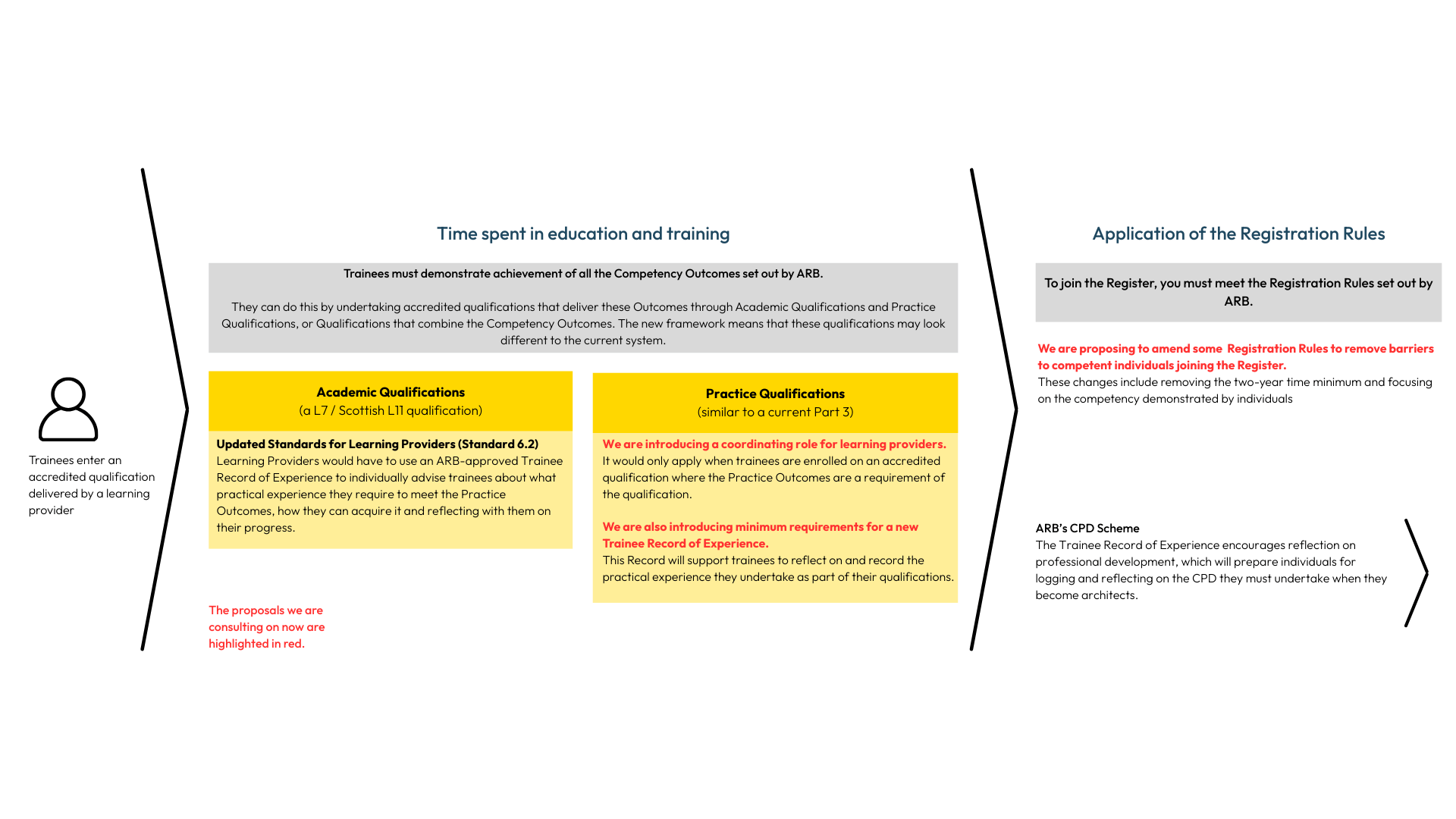
Learning providers should take a coordinating role in facilitating trainees’ acquisition of all the Competency Outcomes.
The role will be implemented through ARB’s Standards for Learning Providers and Accreditation Handbook.
The coordinating role would only apply when trainees are enrolled on an accredited qualification where the Practice Outcomes are a requirement of that qualification.
We expect this would be:
- either an accredited Practice Outcomes qualification, or
- an accredited master’s-level qualification that includes a practical element (e.g. delivers some Practice Outcomes and/or includes a work placement).
We want to set requirements for the role that are proportionate and at a level that improves the support given to trainees. We have targeted the proposed new requirements on specific areas that would help trainees to gain relevant, quality experience necessary for their future practice and will ultimately help to protect the public.
The requirements for the role will be set out in an update to ‘Standard 6 – Student Support’, which will state that learning providers will meet this requirement by:
6.2 Taking a coordinating role in facilitating trainees’ acquisition of the Practice Outcomes, where it is a requirement of the qualification.
Coordination will include using an ARB approved Trainee Record of Experience to support trainees in understanding their progression towards achieving the Practice Outcomes, maintaining a list of suitable employers, and offering advice where trainees have concerns about their employment.
Proposed changes to the Accreditation Handbook
Alongside the Standards, the Accreditation Handbook gives information for learning providers about ARB’s requirements and processes for the accreditation of UK architecture qualifications. We propose that the Handbook is updated to say the coordinating role should include:
- An appointed individual/s provided with sufficient resource to coordinate the provider’s relationship with employers.
- Offering support to trainees to help them find available work placements, including maintaining a list of potential employers to aid them.
- Reasonable assurance that those on the list of available employers are, and remain, suitable practices at which trainees can acquire relevant experience to meet the Practice Outcomes. While the employer does not need to be geographically close to the provider, the provider should be able to maintain contact with the employer for this assurance. It is also recommended that trainees gain experience within the UK as this will help them meet the Outcomes covering regulations, standards, codes of practice and policies related to the development of the built environment.
- Making trainees and employers aware of the ARB guidance on Professional Practical Experience.
- Providing advice to trainees where they have shared concerns about workplace behaviour or employment conditions, referring them to specialist organisations where appropriate.
- Providing trainees with an ARB approved Trainee Record of Experience, in which they will record their progress towards meeting the Practice Outcomes.
- Using the ARB approved Trainee Record of Experience to individually advise trainees about what practical experience they require to meet the Practice Outcomes, how they can acquire it and reflecting with them on their progress.
The consultation asks for views on the proposed changes to the Standards. It also asks whether there is anything missing from the draft Handbook information that would help learning providers understand how to meet the new Standard.
The draft Standards and Accreditation Handbook changes document can be read here.
The Trainee Record of Experience
The Commission identified flaws in the extent to which trainees could work with those supporting them to track and critically reflect on their progress. Trainees spoke about how recording systems were helpful in doing this and the Commission thought these systems should be streamlined, with clear and consistent standards that would help trainees to effectively reflect on their experience, avoiding repetition and inefficiency within their professional development.
Our proposals
We propose the implementation of a Trainee Record of Experience (the TRE).
The TRE will act as a tracking tool for trainees to log the practical experience they gain during their progress to registration. It will support them by acting as a record of their experience undertaken. It is important to emphasise that it is not intended to be a record of performance while undertaking that experience. The TRE will not be assessed by ARB at the point of registration.
The proposed changes to the Standards and Handbook include that learning providers should use an ARB approved record to individually advise trainees on their progress.
We are consulting on the minimum requirements for the TRE. These are the requirements that a record would need to meet for ARB to approve its use by learning providers.
The draft Trainee Record of Experience and advice topics document can be read here.
Proposed minimum requirements for the Trainee Record of Experience
The TRE will:
- Map to the relevant Practice Outcomes
- Provide a standardised format to log experience
- Provide a standardised format to reflect on the experience completed
- Provide a standardised format for recording corroboration from relevant individuals, which is available to the trainee and other relevant individuals
- Be formatted in a way that helps demonstrate achievement of experience and clearly illustrate gaps in experience, so that trainees, their learning providers, and employers have a shared understanding of these gaps
- Be transferable and usable between a trainee’s time at successive employers and/or learning providers
- Be flexible in its format to accommodate the variety of qualification routes and different formats in which experience can be gained
We also propose to provide supplementary advice topics to accompany the TRE. These would help trainees and others involved in their use of the TRE. The topics are:
- Advice for trainees, learning providers and employers on how to complete the TRE effectively
- Case study examples of practical experience that support the Practice Outcomes
- Advice for learning providers on supporting the trainee’s TRE through ‘supervision’ and corroboration
We have not yet made a decision on the format the TRE should take, for example whether it would be delivered by ARB or by another organisation and approved by us. The proposed requirements would be implemented on any format we choose.
Registration Rules
The Commission recommended ARB remove constraints to flexibility and innovation to lead sustainable change across the profession. This would involve changes to our Rules, policies and communication with learning providers.
Our proposals
The Registration Rules set out ARB’s policies and process relating to registration matters, such as how qualified individuals can become registered for the first time.
Our proposed changes to these Rules include a proposal to remove the requirement that applicants for registration have at least two years of practical experience.
This change is made possible by complementary improvements to the quality of experience elsewhere within our plans. The stronger coordinating role for learning providers and a new Trainee Record of Experience will both improve the consistency of good quality experience and reduce the need for the reassurance of a two year minimum.
Consequently, the ‘double counting rule’ will also no longer exist. This is an ARB policy that prevents trainees from using time spent in practice which contributes to the achievement of academic credits to also count that same time towards the minimum two years.
The standard required to join the Register would not be lowered. Trainees will still need to reach the required Outcomes, and this may take them more than two years after their master’s-level qualification.
We are asking for views on draft Registration Rules to implement these changes. The draft changes to the Registration Rules document can be read here.
Recency
- We have considered how to remain assured that candidates have the current knowledge and experience required to practise safely and effectively from the day they join the Register. Topics like legislation and regulations are important for this assurance.
- There is an existing requirement in the Competency Outcomes that trainees understand and are able to “locate, evaluate and apply relevant legislation, regulations, standards, codes of practice and policies related to the development of the built environment” (RE4). This means that if someone has a recent qualification, we can be assured that they are able to locate, evaluate and apply current legislation, regulations and other recency-sensitive knowledge.
- We are currently separately consulting on changes that include an approach towards applicants who qualified more than two years ago. These changes would bring into effect that someone seeking registration more than two years after their final prescribed qualification would need to undertake a Registration Assurance Process.
Guidance for employers and for trainees
We have prepared new supporting guidance for both employers and trainees.
The guidance advises on the expectations of both groups during periods of employment. It also provides clarity about who is responsible for supervision.
Learning providers would need to make trainees and employers aware of this guidance, and as such this material can be used by them to support their trainees. It will reduce the burden placed on them whilst also helping to standardise the information trainees and employers receive.
The consultation asks for views on this guidance. The draft guidance for employers and for trainees document can be read here.
Other changes and next steps
Other changes
The Commission’s recommendations were broad and included changes across ARB’s work, including our Code of Conduct. Many of these are outside the areas above. However, some are related, but are changes we are either already implementing or would implement following the proposals above.
- We have removed any references that the Academic Outcomes must be met before the Practice Outcomes. Some qualifications blend both sets of Outcomes. The structure of these qualifications may mean that some Practice Outcomes are gained before all of the Academic Outcomes have been.
- We will retain advice that trainees should gain significant experience within the UK. Our position is still that those whose practical experience lies solely outside the UK may find it difficult to demonstrate the required level of knowledge and skill to practise safely and effectively in the UK context. This has also been reinforced in the Handbook proposals above.

Next steps
We are consulting on these proposals, inviting feedback from those in the sector to inform the implementation of the PPE Commission’s recommendations. The consultation will remain open until 15 April 2026, and you can respond to the consultation here.
These proposals do not affect our wider transition timeline but, as with the education reforms as a whole, we continue to keep this position under review and will tell learning providers about any changes to timelines.
We will need to decide an appropriate timeline for transitioning to the new Standards and Rules. Learning providers will need time to incorporate them into their qualifications and the way in which they are taught. We propose to publish a timeline following the consultation on proposed changes.
The reference group set up to develop ARB’s proposals on the Trainee Record of Experience will continue its work.
Our engagement work
- We have developed these proposals through thorough two-way engagement with learning providers and those involved in architectural education.
- Three focus groups on the coordinating role were held, attended by 18 learning providers who saw early drafts of our proposals and shared direct feedback. The first was with learning providers who we anticipated were already meeting many of the requirements we were considering. The second was with a range of providers to test our ideas across different sizes, qualification formats and locations. The third was with a smaller group who had told us they would find it difficult to meet one or more of the requirements we were considering.
- We carried out a survey to hear from a wider number of learning providers than we could accommodate in a focus group format. We received 65 responses, 28 of which were official responses on behalf of learning providers.
- Respondents reinforced the findings from the PPE Commission in showing that most respondents had observed the problems it highlighted. Most respondents thought they would definitely or might be able to meet the new ideas for requirements in future. This was also the case for official responses on behalf of learning providers. Many of their concerns were based on misconceptions or a lack of available detail for them to evaluate the ideas.
- We convened a Reference Group to support the development of the Trainee Record of Experience, comprised of learning providers and employers across the UK, and organisations with relevant expertise (RIBA, APSA, SCOSA, APEAS). This Reference Group has now met four times, with discussions focusing on the application of the TRE and its minimum requirements and stakeholders. These discussions helped us define the minimum requirements and areas for supplementary advice.
- Further meetings and discussions included a workshop with the ARB Board, learning providers and employers in Glasgow and a session at our October 2025 conference to discuss the coordinating role and what practices and learning providers need from each other.
- We also held a separate meeting with APEAS to discuss the specific arrangements in Scotland so that we could plan how these would interact with our proposals, and shared updates on our work with APSA and SCOSA.